🥇The only one with a 270° handrail, 12 km/h, 180 kg and 2 years all written

8,5/10our score
270° rotatable handrail written in the listing
Its catch: No handrail height in millimetres
Walking pad with handle
In short
The best walking pad with handle in this comparison is the Cardirun 3.5HP with 12% auto incline: a 270° rotating handrail, 12 km/h, 180 kg and a 2-year warranty are all written in its listing. For 14 km/h, take the UMAY 20%; for a handrail with a written height range, the Cardirun 160 kg.
Three walking pads for three homes: the right answer starts with your desk, your weight and your neighbours, not with the photo.
🥇The only one with a 270° handrail, 12 km/h, 180 kg and 2 years all written
8,5/10our score
270° rotatable handrail written in the listing
Its catch: No handrail height in millimetres
🥈The twin listing, with a Bosch 3.5HP motor and a safety-standard claim

Cardirun Walking Pad with Handle
8,5/10our score
270° rotatable handrail
Its catch: No handrail height in millimetres
🥉The steepest written incline, 20%, and 14 km/h for heavy users

8/10our score
14 km/h, tied for the highest among the 14 handle models bar the WalkingPad X218
Its catch: 195 kg in the title and 180 kg in a bullet
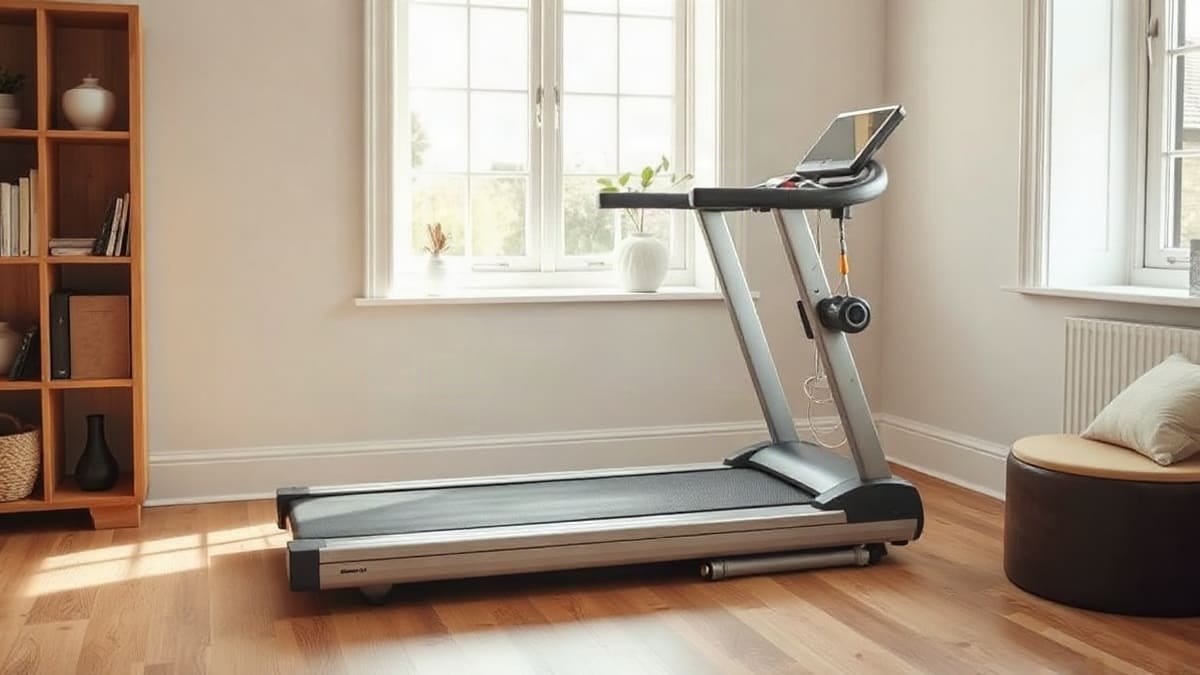
On a video call you step onto the belt at 3 km/h, the call runs long, and you start wishing for something to hold when you glance at the screen. At the weekend you want the same machine to go faster than a stroll. A rail is what makes that possible.
A rail changes what a pad can do: you can hold on at brisk speed, and on some models jog. Safety still starts with our walking pad recalls page, which we keep up to date.
A walking pad with handle is a compact motorised belt with a rail or handlebar you can grip, and in the listings we read the rail folds or rotates. Of the 14 handle models in stock on 28 November 2026, only 2 write a handrail height. This page compares eight of them.
The essentials in 30 seconds
The golden rule: Before you buy, find three figures in the listing: top speed in km/h, maximum user weight in kg, and the handle height. Only 2 of 14 write the last one.
775-1,040 mm on one, 85 and 95 cm on another; read on 28 November 2026
the other seven say nothing, and your Consumer Rights Act 2015 rights apply either way
195 and 180 kg on the UMAY, 180 and 136 kg on a 15% incline model; read on 28 November 2026
Take the Cardirun 3.5HP if
you walk at a desk on weekdays, jog at weekends, and want 180 kg and 2 years in writing
12 km/h, 180 kg
Take the UMAY 20% if
you jog fast or need the highest written limit, and will ask the seller about the warranty
14 km/h, 20% incline
Neither? Then
the HADMAX if you only walk and want a rail that folds down out of the way
1-6 km/h, 2 years
In short
With 8.5 out of 10 the Cardirun 3.5HP is our top walking pad with handles of the eight, ahead of the UMAY 20% (8.0) and the Cardirun 160 kg (7.8). It is the only one of the eight with a rotating rail, 12 km/h, 180 kg and 2 years written together.
A walking pad with handle has to answer three questions that listings rarely answer in one place. Can you hold on? Can you still go faster than a stroll? What weight does the frame carry? The Cardirun 3.5HP answers all three in its own text: a 270° rotatable handrail, a running mode of 1-12 km/h, and support for users up to 180 kg.
It is not the fastest. The UMAY and the Cardirun 160 kg both write 14 km/h, and the WalkingPad X218 writes 18 km/h. It wins because its figures sit together and do not contradict each other. Its twin listing, the Cardirun with a Bosch motor, repeats the same four numbers. Its weak point is that the listing gives no handrail height, so you should ask the seller.
| Your case | Choose | The figure that decides | What it means |
|---|---|---|---|
| Desk walking plus weekend jogging | Cardirun 3.5HP | 12 km/h, 180 kg | Written warranty of 2 years, one of only three in the 14 |
| Fast running, heavy user | UMAY 20% incline | 14 km/h, 195 kg in the title | Bullets say 180 kg, so confirm the limit first |
| You want a measured handrail | Cardirun 160 kg | 775-1,040 mm | The widest written range, 265 mm of adjustment |
| Walking only, rail out of the way | HADMAX adjustable handle | 85 and 95 cm | Two fixed positions, 136 kg limit |
| Speed above everything | WalkingPad X218 | 18 km/h | No noise or warranty figure written |
Read in: The eight listings on Amazon.co.uk, read on 28 November 2026 ; overall score: mean of four notes out of 10, same scale across the site ; counts over 14 handle models in stock, our reading of each listing
If you want the rail and a steep slope, read our incline walking pad page. If space matters more, the foldable walking pad page starts from storage height.
In short
The eight models write 6 to 18 km/h, 136 to 195 kg, and 40 to 45 dB where noise is given; two of them state a handrail height and four state no warranty at all.
We chose these eight from the 14 handle models in stock on 28 November 2026 because each writes a top speed, a motor, and something about its handle. We left out the listings that repeat another machine, such as the pink version of the Cardirun 6-in-1, and the flat decks with no rail.
The order follows the overall score, the mean of four notes out of 10: speed and incline, motor and load, noise, warranty. The notes judge the figures a machine is written with, compared with the rest of the range. They are not laboratory measurements. We leave prices to the buttons on each card, which show today's figure, because a number written here would be out of date by tomorrow.
The 8 walking pads on this page, side by side. n.p. marks a figure the maker does not state. The links in this table open Amazon.co.uk; a purchase can earn us a commission.
| Rank | Walking pad | Top speed | Max user weight | Handle | Noise | On Amazon |
|---|---|---|---|---|---|---|
| 🥇 | Cardirun 3.5HP Walking Pad8,5/10 | 12 km/h (running mode); 6 km/h (walking mode) | 180 kg | 270° rotatable handrail | under 40 dB | See it on Amazon£299.99Read our review |
| 🥈 | Cardirun Walking Pad with Handle8,5/10 | 12 km/h (running mode); 6 km/h (walking mode) | 180 kg | 270° rotatable handrail | under 40 dB | See it on Amazon£299.99 |
| 🥉 | UMAY 20% incline treadmill8/10 | 14 km/h | 195 kg in the title, 180 kg in a bullet | "Foldable & Handle" in title, not described in bullets | under 45 dB | See it on Amazon£185.24Read our review |
| 4 | Cardirun TM0327,8/10 | 14 km/h | 160 kg | 775-1,040 mm, 270° swivelling | as low as 45 dB | See it on Amazon£237.48Read our review |
| 5 | UMAY 15% incline walking pad7/10 | 12 km/h | 180 kg in the title, 136 kg in a bullet | safety handrail, no height written | under 45 dB | See it on Amazon£117.32Read our review |
| 6 | Cardirun 6-in-1 Walking Pad6,8/10 | 10 km/h (running mode); 6 km/h (walking mode) | 145 kg | handle bar, no height written | under 40 dB | See it on Amazon£103.55 |
| 7 | HADMAX Walking Pad6/10 | 6 km/h | 136 kg | two positions, 85 and 95 cm, folds down | 45 dB | See it on Amazon£239.99 |
| 8 | WalkingPad X2184,8/10 | 18 km/h | 136 kg | foldable side handles, no height written | not written | See it on Amazon£849.00Read our review |
Price on Amazon.co.uk on 29/11/2026 at 12:02 (UK time) · Details
Source: the listings on Amazon.co.uk read on 28 November 2026. "Not written" means the listing does not give the figure.
In short
Below you will find, for each machine, six figures, the notes, the buyer it suits, and the question to put to the seller.
Our notes cover what each listing writes, and where a listing contradicts itself or leaves something out, the point is under the model's weaknesses. Four machines have a full review of their own with the same figures line by line: the Cardirun 3.5HP, the UMAY 20% incline, the Cardirun 160 kg handrail and the WalkingPad X218. The scoring is explained on the methodology page.
You walk at a desk on weekdays and want to jog at weekends with a rail to hold
Who it suits: Home workers who want one machine for walking and jogging, up to a user of about 150 kg, and who accept asking the seller for the handrail height.
Score out of 10, the mean of four criteria, each judged against the other walking pads, explained in How to choose
The Cardirun 3.5HP is the best walking pad with handle here because it writes four figures together that no other single listing combines: a 270° rotating rail, 12 km/h, 180 kg and 2 years. The UMAY and the Cardirun 160 kg go faster, at 14 km/h, but neither writes a warranty. At under 40 dB it is also the quietest written. Ask the seller for the rail height in millimetres before ordering. Its twin listing repeats these figures with a Bosch motor.
You want the same 12 km/h, 180 kg machine and prefer a listing that names the motor maker and a standard
Who it suits: Buyers of the Cardirun 3.5HP who want the Bosch motor wording and the EN ISO 20957-1 claim in writing.
Score out of 10, the mean of four criteria, each judged against the other walking pads, explained in How to choose
This listing repeats the Cardirun 3.5HP's 12 km/h, 180 kg and 2 years, and adds two claims the other lacks: a named Bosch motor and an assessment to EN ISO 20957-1 by SGS. It ties on the 8.5 score. We rank it second because the other listing also writes remote, app and voice control. If you want the written standard, it is the one to read; ask for the report.
You jog fast, weigh a lot, and will check the weight limit and warranty with the seller
Who it suits: Heavier or faster runners who want the highest written limit and the longest belt, 108 cm.
Score out of 10, the mean of four criteria, each judged against the other walking pads, explained in How to choose
The UMAY 20% is the fastest and steepest here with a long belt: 14 km/h, 20% and 108 cm. It scores 8.0 and loses to the Cardirun 3.5HP on one thing, the written warranty, which is missing. The listing contradicts itself on weight (195 and 180 kg) and on incline type. If you jog fast, it is the pick, but ask which figures are right and what the warranty is.
You want to know exactly where the rail sits and also need 14 km/h
Who it suits: Taller or shorter users who need to check the grip height, up to about 133 kg.
Score out of 10, the mean of four criteria, each judged against the other walking pads, explained in How to choose
The Cardirun 160 kg is the only listing that writes how high the rail goes, 775 to 1,040 mm, a 265 mm range. It also writes 14 km/h, matching the UMAY. Against the Cardirun 3.5HP it gives up 20 kg of capacity and the written warranty. If grip height is your concern, it is the one that lets you check before you buy. Before you order, measure your ceiling height against the raised rail and keep the box for the first 30 days, when the law lets you reject a faulty pad.
You want a steep manual slope and a fixed rail, and will confirm the weight limit
Who it suits: Home users who want an incline and a rail and will check whether 180 or 136 kg is correct.
Score out of 10, the mean of four criteria, each judged against the other walking pads, explained in How to choose
This model offers a 15% manual slope and 12 km/h with a fixed safety handrail, which puts it in the middle of the field at 7.0. The weight limit is the question: the title says 180 kg and a bullet says 136 kg, a 44 kg gap. Use the lower number unless the seller confirms otherwise, and ask for the warranty. Ask the seller for the continuous motor rating if the listing only gives a peak figure, and check the belt width against your stride.
You are under about 170 cm and want light jogging, folded at 11 cm
Who it suits: Shorter users and small flats, up to a user of about 121 kg.
Score out of 10, the mean of four criteria, each judged against the other walking pads, explained in How to choose
The Cardirun 6-in-1 is the quiet, low-fold choice at 6.8: under 40 dB and 11 cm folded, the lowest of the eight. It also writes a recommended user height of 170 cm, a figure most listings leave out. The belt is 92 cm and the limit 145 kg, so it suits shorter, lighter users rather than a long-striding runner. Compare its stated user weight with yours plus a fifth for headroom, and make sure the handle locks in both the walking and running positions.
You only walk, want a rail you can fold away, and keep the speed at or below 6 km/h
Who it suits: Walkers who want a two-position rail and a 2-year warranty, up to about 113 kg.
Score out of 10, the mean of four criteria, each judged against the other walking pads, explained in How to choose
The HADMAX is the walker's choice at 6.0: two rail heights, 85 and 95 cm, which fold down, and a 2-year warranty, which only three of the 14 write. Its top speed is 6 km/h, half the Cardirun 3.5HP's 12, so it does not suit a jogger. It is for users under about 113 kg who want steady support and an easy fold. Read the noise figure, if one is given, against the 45 dB that our scoring treats as quiet, and keep the safety key clipped on from the first walk.
You want the highest written speed and a vertical fold, and accept a 136 kg limit
Who it suits: Fast runners up to about 113 kg who care about storage and an app.
Score out of 10, the mean of four criteria, each judged against the other walking pads, explained in How to choose
The WalkingPad X218 is the fastest of the eight at 18 km/h, 4 km/h above the UMAY and the Cardirun 160 kg, and its side handles fold with the deck. It scores 4.8 because the listing writes no noise level and no warranty, and 136 kg is low for a title that says "heavy people". Ask about both before buying. Check how the side handles fold before you buy, since storage under a bed depends on the folded height rather than the deck alone.
In short
Check top speed, written user weight, handle height, noise and warranty, in that order; most listings fail at the second check.
Choosing a walking pad with handle is easier if you read one listing at a time and tick off five lines. The order matters. A handle height is of no use if the frame carries less than you weigh, and a fast belt is of no use if the rail is fixed at the wrong height for your arms.
Find the km/h figure. Of the 14 handle models, 3 write 14 km/h, 4 write 12 km/h and one stops at 6 km/h. Our own line: below 8 km/h is walking, 8 and above is a jog.
Add 20% to your weight. A 180 kg limit suits a user of about 150 kg. Two of 14 listings give two different limits, so look for the lower one.
Look for millimetres or centimetres, not "adjustable". Only 2 of 14 write them. Without a figure, ask the seller before ordering.
Find the dB figure. 13 of the 14 write one, from under 40 to 45 dB; a handle does not change that.
Look for years. 7 of 14 write one. The seller owes you the Consumer Rights Act 2015 rights anyway; a written warranty is extra.
The same checks seen from your question:
| If you ask | Look at | The figure | What it means |
|---|---|---|---|
| Can I jog on it? | Top speed in km/h | 8 or more | One machine stops at 6 km/h and walks only |
| Will it carry me? | User weight in kg | Your weight plus 20% | 180 kg means a user up to 150 kg |
| Can I grip it comfortably? | Handrail height | 775-1,040 mm on one listing | Two of 14 write a height at all |
| Will it annoy the room below? | Noise in dB | Under 40 to 45 dB | The quietest written is under 40 dB |
| Is there more than the legal minimum? | Warranty in years | 2 years on three listings | Half the 14 write none |
For a rail height that suits you, stand upright and bend your elbow to a right angle: the grip should sit at about that height. This is our rule of thumb, not a standard. Check that the written range reaches it.
Common mistake : a handle on the listing means a handle you can adjust
Every one of the 14 listings has "handle", "handrail" or "handlebar" in its title, yet only 2 write a height and 3 write a 270° rotation. One of them, a LONTEK listing, has "handle" in its title and then describes a flat deck with no column to fold down and calls it a handle-free pad. Read the bullets, not just the title.
Read in: Our reading of 14 Amazon.co.uk listings for handle walking pads in stock, 28 November 2026 ; the 8 km/h line and the elbow rule are ours, not a standard ; keyword counts may miss a figure written elsewhere on the page
In short
Get a walking pad with a handle if you want to hold on while you walk, jog above 8 km/h, or share the machine with someone less steady; skip it if you only stroll under a desk and want the thinnest deck.
A rail does two jobs. It steadies you when you look away from the belt, and it gives you something to hold when the belt speeds up. A flat deck sits lower and slides under a sofa more easily, but it leaves your hands free for nothing but the desk. In the listings we read, the rail models are also the ones that write the higher speeds: of the 14, only one stops at 6 km/h.
The price of the rail is storage and folding. The Cardirun 3.5HP writes 17.5 cm tall when folded; the HADMAX writes about 14 cm for the deck with the rail folded down. A fixed rail adds height you cannot remove, so measure the cupboard before ordering.
You are new to treadmills, you walk more than 4 km/h, or you step on while tired. Holding on takes weight off your ankles for the first minutes.
You mostly stand at a desk and walk slowly. A fixed rail can block a drawer or hit your knee, which a flat deck never does.
You plan to jog. The two machines writing 14 km/h and the one writing 18 km/h all come with a rail or handles.
Clip the safety key to your clothes. The rail does not stop the belt when you step off.
If you would rather save money than gain a rail, our cheap walking pad page starts from the lowest budget. For the short answer on a flat deck, see the under desk page.
In short
You can run on a walking pad only if the listing writes a top speed of about 8 km/h or more; of the 14 handle models, 13 do, and the exceptions are the HADMAX and the 4 "walking mode" bands inside the Cardirun listings.
The question is really about the belt, the motor and the weight. Running puts more force on the belt at each stride. That is why the models above write a 3.0 to 3.5 HP motor, a belt of 92 to 108 cm and a user limit. A belt of 90 cm or less is short for a longer stride; the longest written, on the UMAY, is 108 cm.
The Cardirun 3.5HP writes two modes: Running 1-12 km/h and Walking 1-6 km/h, alongside a 270° rotatable handrail. The listing does not say whether the rail position switches the mode, so ask the seller before you assume it does. The same listing recommends no height limit; the Cardirun 6-in-1, by contrast, writes a recommended user height of 170 cm (5 ft 7 in) for walking and light workouts, a figure few listings give.
Speed changes the time on the belt a great deal:
| Speed | Time for 5 km | What it means |
|---|---|---|
| 6 km/h | 50 min | The top of the HADMAX, brisk walking |
| 8 km/h | 37 min 30 s | The speed one flat deck calls a jog |
| 10 km/h | 30 min | The ceiling of the Cardirun 6-in-1 |
| 12 km/h | 25 min | The Cardirun 3.5HP's written top |
| 14 km/h | 21 min 26 s | The UMAY and the Cardirun 160 kg |
A concrete example : a 75 kg runner and a 12 km/h machine
At 75 kg, adding 20% gives 90 kg, well under the 180 kg of the Cardirun 3.5HP and the 136 kg of the HADMAX. The weight limit is not the problem; the 6 km/h ceiling of the HADMAX is. This is our calculation from written figures, not a measurement.
Read in: Cardirun, UMAY, HADMAX and WalkingPad listings on Amazon.co.uk, read on 28 November 2026 ; times: our calculation, distance divided by speed ; the 8 km/h line is ours
In short
Four rail types appear in the 14 listings: a rotating bar (3 models), a height-adjustable rail (2), a fold-down handle (1) and side handles (1), and each tells you where the machine fits.
The type of rail decides how the machine behaves in a small flat. A rotating or fold-down rail can be moved out of the way. Fixed side handles, as on the X218, stay up but fold with the deck when you tip it vertical.
| Type | Models | Written figure | What it means |
|---|---|---|---|
| 270° rotating bar | Cardirun 3.5HP, its twin, Cardirun 160 kg | 270°, 775-1,040 mm on one | The most flexible position for different heights |
| Two-position handle | HADMAX | 85 and 95 cm | Two settings, folds down when not used |
| Safety handrail | 15% incline model | no height | Fixed, with cup holder |
| Foldable side handles | WalkingPad X218 | no height | Folds with the vertical-fold deck |
Not all of them. Of the 14 listings with "handle" in the title, one describes a flat deck with no rail, and a second flat model, a UMAY under-desk listing, is titled "no handle" in its own bullets. Many walking pads sold for under-desk use are flat by design.
Those on this page do. The rail is part of the machine, built in or pre-installed. One listing says to "secure the handrail once" when you unfold; none of the 14 sells a retrofit handle.
In short
Of the 14 handle listings, 2 write a handrail height, 7 write a warranty, and 2 give two different weight limits in the same text.
A listing for a walking pad with handle is a sales text. It tells you how many layers the belt has and how many HIIT programmes are installed, but rarely the figure that decides whether the rail fits you. Our count covers the 14 handle models in stock on 28 November 2026, plus the 186 listings we read across the whole range for context.
| What you look for | Handle listings that write it (of 14) | What it means |
|---|---|---|
| Handrail height | 2 | Almost no one tells you where your hands will be |
| 270° rotation | 3 | Rotation is written more often than height |
| Warranty in years | 7 | Half the models leave it to your legal rights |
| Noise in dB | 13 | Written almost everywhere, from under 40 to 45 |
| One consistent weight limit | 12 | Two contradict themselves |
Across the full range of 186 listings, 156 write a top speed, 128 a maximum weight and 39 a warranty. So handle models are better than average on warranty, with 7 of 14 (50%) against 39 of 186 (21%), and still miss the handle height.
Where a listing contradicts itself, we say so. The UMAY writes 195 kg in the title and 180 kg in a bullet, and its title says "manual incline" while its first bullet says "auto incline". The 15% incline model writes 180 kg in the title and 136 kg in a bullet. Questions to put to any seller:
Read in: Our reading of 14 handle listings and 186 listings in the range on Amazon.co.uk, 28 November 2026 ; the count is by keyword, so a figure written elsewhere may be missed
In short
Add 20% to your own weight to find the limit you need: a 180 kg listing suits a user of about 150 kg, and a 136 kg listing a user of about 113 kg.
Our reference point is the user's weight plus 20%, so that the motor and frame are not at the edge of their rating. Written limits among the eight run from 136 to 195 kg. The table turns each limit into a user weight.
| Written limit | User weight at +20% | Models | What it means |
|---|---|---|---|
| 195 kg | 162 kg | UMAY 20% (title) | Confirm: its bullet says 180 kg |
| 180 kg | 150 kg | Cardirun 3.5HP and twin | Consistent in both bullet and title |
| 160 kg | 133 kg | Cardirun 160 kg | A single figure in the listing |
| 145 kg | 121 kg | Cardirun 6-in-1 | Recommended up to 170 cm tall |
| 136 kg | 113 kg | HADMAX, WalkingPad X218 | The X218 listing says "for heavy people" |
The last row is worth a pause. The X218 listing is titled "for Heavy People" but writes 136 kg, our 113 kg user. If you weigh more, use a machine with 160 kg or above.
In short
Most handle models arrive 90% pre-assembled: unfold the deck, lock the rail, clip the safety key, and start at 1 km/h.
We have no Yagud listing, so we cannot describe its handle. The steps below come from the listings of the machines on this page and apply to any pre-installed walking pad with handle; follow your own manual for the exact fixing.
The Cardirun 160 kg listing writes 90% pre-assembled, three steps, under 10 minutes. The HomeFitnessCode model says "secure the handrail once".
Raise the rail until it clicks, then pull on it. It should not move under your weight.
Put it on a hard floor, not a carpet: one listing warns that carpet blocks heat dissipation.
The magnetic safety key goes on your clothing so that the belt stops if you step off.
Start at 1 km/h, hold the rail, and raise the speed after a minute.
We do not advise it. None of the 14 listings sells a retrofit rail, and a home-made one is bolted to a frame whose weight limit and warranty depend on the maker's design. If you want a handle on a flat deck, choose a model that already comes with one.
For belt lubrication and care, the under desk page covers it, and the glossary explains HP and CHP.
Unfold the deck on a flat, hard floor, raise or lock the handle until it clicks, clip the safety key to your clothing and start at the lowest speed for the first ten minutes. Check that the belt runs centred before you speed up; if it drifts, the manual explains the small turns on the rear roller bolts.
Wipe the deck and the handle after use, keep the motor cover free of dust, and lubricate the belt with the silicone the maker names, at the interval its manual gives. Fold the handle down before storing the pad on its side only if the listing says the model allows it.
In short
Allow roughly 365 kWh a year if the machine averages 500 W for 2 hours a day (our assumption), and expect your Consumer Rights Act 2015 rights to apply for 30 days to reject and 6 months for a presumed fault.
The listings give motor power in horsepower and rarely an average draw in watts, so we assume 500 W. Used for 2 hours a day over 365 days, that is 365 kWh a year, or 182.5 kWh at one hour a day. Peak HP is not the same as continuous power, so a 3.5HP machine does not draw 2,610 W for long. This is our assumption, not a written figure.
Two listings quote a motor rated past 3,800 hours. At 2 hours a day that is 1,900 days, or about 5.2 years; at one hour a day, 10.4 years. It is the maker's figure and we cannot confirm it.
Your rights: under section 22 of the Consumer Rights Act 2015 you can reject faulty goods within 30 days. Under section 19, a defect appearing within 6 months is presumed to have been there at delivery. For online purchases, the Consumer Contracts Regulations 2013 give 14 days to cancel from receipt. For disposal, the WEEE Regulations 2013 oblige a distributor selling a new electrical appliance to take back an old equivalent one for one; ask the seller how take-back works.
Read in: Consumer Rights Act 2015, sections 19(14)-(15) and 22 ; Consumer Contracts (Information, Cancellation and Additional Charges) Regulations 2013, regulations 30(3) and 34 ; WEEE Regulations 2013, regulation 42 ; motor hours: two Amazon.co.uk listings, 28 November 2026 ; kWh: our calculation
All 14 titles say "handle". One listing describes a flat deck with no column.
Two of 14 listings contradict themselves. Use the lower number.
A 14 km/h top is little use on a 90 cm belt if you jog.
Seven of 14 write none. Ask who handles a fault in year two.
Common mistake : holding the rail all the time makes it easier
Holding on tightly cuts your arm swing and shifts your weight. Rest your hand lightly, and clip the key every time.
Worth knowing
Speed in km/h, weight in kg, handle height in mm, noise in dB, warranty in years. If one is missing, ask before you pay.
Yes, if you walk fast, jog, or want steadiness; see our answer on whether to get a walking pad with a handle above. For a slow desk stroll only, a flat deck is thinner.
Only if the listing writes about 8 km/h or more. Twelve of the 14 handle models write 10 km/h or above; the Cardirun 6-in-1 writes 10 km/h and the HADMAX 6 km/h.
Yes, on a model with a motor of 2.5HP or more and a belt of around 100 cm. On the Cardirun 3.5HP that means 12 km/h; on the HADMAX, no.
Several write 12 to 18 km/h, so they are built to, but the weight limit and belt length decide. Add 20% to your weight and compare with the written limit.
Usually, because you can steady yourself. The rail does not replace the safety key, which stops the belt when you step off.
Aim for a grip at about elbow height when you stand upright. Only the Cardirun 160 kg (775-1,040 mm) and the HADMAX (85 and 95 cm) write a height.
Yes. The Cardirun 3.5HP folds to 17.5 cm, the HADMAX folds the rail down, and the X218 uses a vertical fold. Measure your cupboard first.
With the rail folded down or rotated, some do. The HADMAX deck is about 14 cm thick; check the rail position under your own desk.
The Cardirun 3.5HP, its twin and the Cardirun 6-in-1 write under 40 dB. Others write 45 dB, and the X218 writes no figure.
It is if the rail folds or rotates. The Cardirun 6-in-1 writes 11 cm folded; a fixed rail needs more height.
Yes, and most people do once they are used to the belt. Keep the rail within reach and clip the safety key.
Rarely. The Cardirun 160 kg writes 90% pre-assembled, and the Cardirun 3.5HP writes "no assembly required".
Where the figures come from. On 28 November 2026 we read 186 Amazon.co.uk listings for walking pads. Of the 14 handle models in stock, we picked eight that write a top speed, a motor and a handle feature. Figures are taken from each listing's title and bullets.
How we score. Each model gets four notes out of 10, for speed and incline, motor and load, noise and warranty, calculated from the written figures compared with the range. The overall score is the mean to one decimal. The notes judge the product's figures, not the quality of the listing's writing.
What our second reading corrected
What we left out. Flat decks without a rail, colour variants of a model already listed, and listings with no top speed. Limits. A keyword count can miss a figure written elsewhere; we do not measure noise or load ourselves.
Our sources
The Cardirun 3.5HP with 12% auto incline is the walking pad with handle we would choose for most buyers: a 270° rotating handrail, 12 km/h, 180 kg and a 2-year warranty are all in its listing. For 14 km/h, the UMAY is the alternative, once you have asked about its weight limit and warranty.
Before any purchase, read five figures: speed, weight, handle height, noise and warranty. If one is missing, ask. Our best walking pad comparison shows the whole range, and the incline page goes further on slopes.
In short, the best walking pad with handle for each need:
A 2 in 1 walking pad lifts its rail for a jog and lowers it to go under a desk; a walking pad with arm rest keeps a fixed bar at the front. If you need a 2 in 1 walking pad for a desk, check that the rail folds flat enough. A walking pad with arm rest gives you something to hold on a slope, and a walking pad with handrail is easier to step on for an older user. For one brand, see the WalkingPad and KingSmith models or the best Urevo walking pad.


